 How-to
What Happens If Both Drivers Are at Fault?
Last Updated: November 1, 2026
Quick Summary
What happens if both drivers are at fault? In California, both drivers can usually still recover compensation, reduced by their own share of responsibility under pure comparative negligence. Your award is your total damages minus your percentage of fault, so a driver found 40% at fault on $50,000 in damages can recover $30,000.
- California follows pure comparative negligence, so you can recover even if you were mostly at fault.
- Your recovery equals your total damages multiplied by the other driver's share of fault.
- The first fault percentage an insurer offers is a negotiating position, so ask for the evidence behind it.
- Document the scene, see a doctor promptly, and notify your own insurer right away after the crash.
- Some states bar recovery at a 50% or 51% fault threshold, so confirm which rule applies to your case.
Table of Contents
- How Shared Fault Works When Both Drivers Share the Blame
- Comparative Negligence in a Car Accident Explained
- Car Accident Fault Percentage Examples and What They Mean for Your Claim
- What to Do After a Car Accident When Both Drivers Are at Fault
- How Insurance Works When Both Drivers Are at Fault
- Insurance Fault Versus Legal Liability
- Scheduling a Free Consultation After a Shared-Fault Crash
- Frequently Asked Questions
A common question after a crash is: what happens if both drivers are at fault? The honest answer is that shared fault is common, and it doesn't end your claim.
This guide walks through how shared fault works, how fault percentages affect your claim, and what to do next. You can also read what to do after a car accident that was not your fault for steps to protect your claim.
How Shared Fault Works When Both Drivers Share the Blame
When both drivers contributed to a crash, the law looks at each person's share of responsibility. Fault is rarely all-or-nothing.
Fault is usually split by percentage. One driver might be 70% responsible, and the other 30%. The percentages reflect how much each driver's actions caused the collision.
- Speeding or running a red light often adds to a driver's share
- Following too closely or distracted driving can also raise it
- Failing to yield or signal may shift part of the blame
Shared fault doesn't erase a claim. It changes how much money you can recover.
Comparative Negligence in a Car Accident Explained
California uses pure comparative negligence. Under this rule, you can recover damages even if you were mostly at fault.
For example, if your damages total $50,000 and you are 40% at fault, you can recover $30,000.
This is different from contributory negligence, used in a few states, where any fault by the injured person can block recovery entirely (comparative negligence | Wex | US Law).
Car Accident Fault Percentage Examples and What They Mean for Your Claim
Fault percentages are built from evidence, and those numbers drive a large part of your recovery. Understanding how the math works, and where it can be challenged, can help you avoid accepting a low offer.
How the math works in practice
Under a pure comparative negligence rule, your recovery is your total damages multiplied by the other driver's share of fault. Here is how different splits play out on the same $40,000 in damages:
| Fault Split (You / Other Driver) | Your Damages | Your Recovery | What It Means |
|---|---|---|---|
| 50% / 50% | $40,000 | $20,000 | Dead even, you recover half |
| 30% / 70% | $40,000 | $28,000 | You were mostly not at fault |
| 70% / 30% | $40,000 | $12,000 | You were mostly at fault but still recover |
| 80% / 20% | $40,000 | $8,000 | A small recovery is still possible |
| 99% / 1% | $40,000 | $400 | Even minimal fault by the other driver preserves a claim |
Two things stand out. First, a driver who is mostly responsible can still recover something. Second, a ten-point swing in the fault split can move thousands of dollars, which is why insurers fight hard over percentages.
How fault percentages are actually established
Adjusters typically weigh several categories of evidence:
- The police report. Officers often note contributing factors (unsafe speed, failure to yield, following too closely). These notations are persuasive but not binding.
- Vehicle damage and point of impact. Damage patterns can corroborate or contradict each driver's account of how the collision happened.
- Scene evidence. Skid marks, sight lines, traffic control devices, and road conditions help reconstruct what each driver could have seen and done.
A common pattern is for the other driver's insurer to open with a fault split favorable to its policyholder, often assigning you a higher percentage than the evidence supports. That opening number is a negotiating position, not a finding.
How to challenge a fault percentage
If you believe the proposed split is wrong, you are not stuck with it. Practical steps include:
- Request the basis in writing. Ask the adjuster what evidence supports the percentage. Vague answers often signal a soft position.
- Submit contradicting evidence. Photos, witness contact information, vehicle damage documentation, and a reconstruction-friendly description of the scene can shift the analysis.
- Separate property damage from injury claims. Insurers sometimes resolve the vehicle damage claim quickly while leaving the injury claim open, do not let a quick property settlement lock in a fault percentage for your injury claim.
- Ask about independent review. Some disputes can be escalated within the insurer or, in some circumstances, to an independent appraisal or dispute process. A lawyer can tell you which options fit your situation.
- Preserve the option to litigate. A court is not bound by an adjuster's opinion. If negotiation stalls, filing suit keeps pressure on and lets a judge or jury decide the split.
How the split applies to different parts of your claim
Fault percentages are usually applied to the total of your economic and non-economic damages, but the mechanics can differ by claim type:
- Property damage. Repair estimates and total-loss valuations are usually straightforward, and the fault split is applied to the agreed value.
- Medical expenses. Past and future treatment costs are documented through bills and records; the split reduces the recoverable amount.
- Lost wages. Pay stubs and employer letters establish the loss; the split applies the same way.
Because the same percentage can produce very different outcomes depending on how damages are valued, it is worth reviewing any proposed split against your full damages picture, not just the repair bill.
A quick reality check on thresholds
Some states use modified comparative negligence rules with a threshold, for example, barring recovery if you are 50% or 51% at fault (comparative negligence | Wex | US Law). Under a pure rule, no such bar applies. If you were hurt in a crash outside your home state, or the other driver is from another state, the threshold question can change your recovery.
The fault percentage is the single biggest lever on your recovery. Treat the first number you hear as an opening offer, ask for the evidence behind it, and document your own account early.
What to Do After a Car Accident When Both Drivers Are at Fault
When fault is shared, the first hours and days matter more than in a clear-liability crash. Evidence disappears, memories fade, and insurers start building their file immediately. Here is a practical, step-by-step approach.
In the first hour: safety and the official record
- Move to safety and call 911 if anyone is hurt or the vehicles block traffic. A police report creates an official record that adjusters rely on.
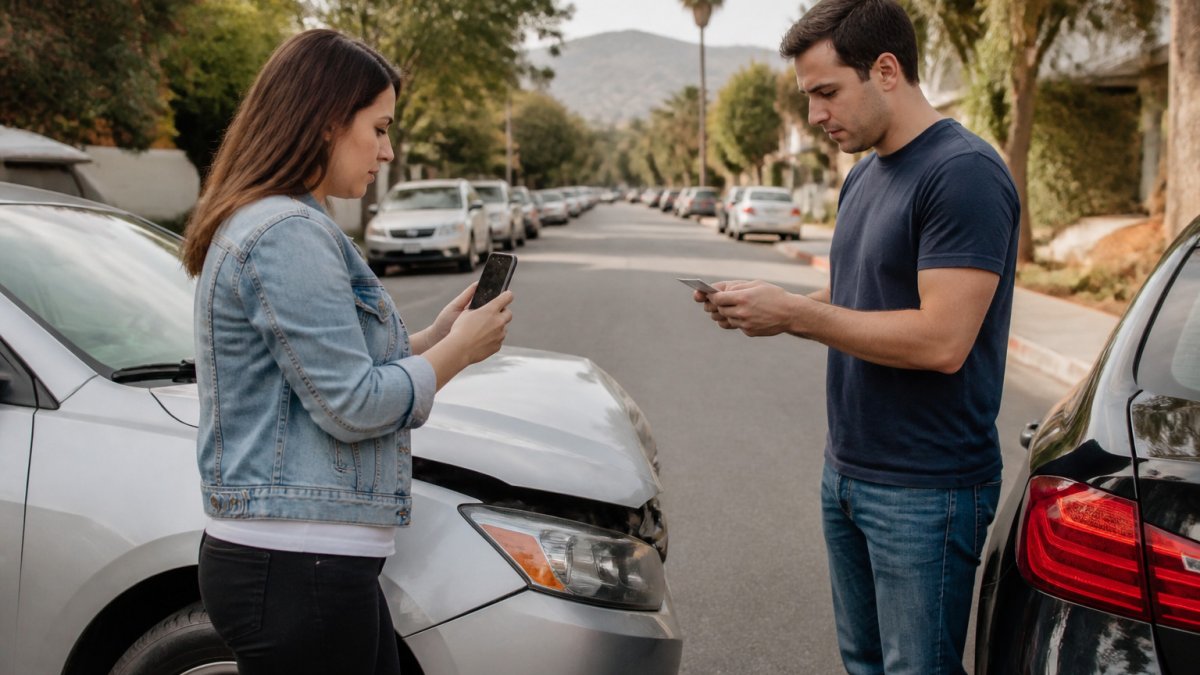
- Exchange information, names, insurance cards, driver's license numbers, license plates, and contact details. Note the other driver's insurer and policy number.
- Avoid admitting fault or guessing. Statements like "I didn't see you" or "I was going a little fast" can be quoted later. Stick to facts: what you were doing, what you observed.
In the first 24-48 hours: preserve evidence
- Photograph everything, vehicle damage from multiple angles, the scene, skid marks, traffic signals, road signs, weather conditions, and any visible injuries. Timestamped photos are strongest.
- Collect witness names and contact information. Independent witnesses are valuable because they are not tied to either driver.
- Note the scene conditions, time of day, lighting, road surface, and traffic volume. These details support or undercut fault theories.
In the first week: documentation and deadlines
- Start a file. Keep copies of the police report, medical records and bills, repair estimates, photos, witness information, and every letter or email from any insurer.
- Track deadlines. Notice requirements and limitation periods vary. Missing a deadline can bar your claim entirely, regardless of fault. Confirm the applicable deadlines with a lawyer if you are unsure.
- Log your recovery. A simple daily note about pain, treatment, missed work, and activities you could not do helps document non-economic damages later.
If the insurer denies your claim or assigns you too much fault
A denial or an unfavorable fault split is not the end of the process. Practical next steps include:
- Ask for the denial in writing and the specific evidence relied on.
- Submit a written dispute with your supporting evidence, photos, witness statements, medical records, and a clear timeline.
- Request reconsideration through the insurer's internal review process.
- Consider an independent review or appraisal where available for property damage disputes.
- Consult a lawyer about negotiation, demand letters, and, if needed, filing suit before the limitation period runs.
Special situations that change the playbook
- Multiple vehicles. Fault can be split among three or more drivers, and each insurer may point at the others. A clear timeline and diagram of the sequence of impacts helps.
- Passengers. Passengers are usually not at fault and may have claims against one or more drivers. Their statements can also be valuable evidence.
- Uninsured or underinsured motorist coverage. If the at-fault driver has little or no insurance, your own UM/UIM coverage may respond. Notify your insurer early and follow the policy's requirements.
The best time to protect a shared-fault claim is before the adjuster builds the file. Document the scene, see a doctor, notify your insurer, and keep every record. If a denial or unfair fault split arrives, dispute it in writing and get advice before any deadline passes.
How Insurance Works When Both Drivers Are at Fault
Each driver's insurance company will investigate the crash and try to assign fault. These adjusters work for the insurer, not for you.
Expect the other driver's insurer to argue that you were more responsible. Don't accept a fault split without reviewing the evidence. A personal injury attorney can help you organize your claim, paperwork, and communication with insurers so you're not handling it alone. See attorney-led help after an auto accident for how this support works.
Insurance Fault Versus Legal Liability
Insurance fault and legal liability are related, but they aren't the same.
- Insurance fault is the adjuster's opinion about who caused the crash, used to decide payouts.
- Legal liability is what a court would decide based on the evidence and state law.
An insurer may take a position that a court would reject. If the two disagree, you still have options, including negotiation and, when needed, a lawsuit. Learn more about how California fault is decided in a rear-end crash.
Scheduling a Free Consultation After a Shared-Fault Crash
If you're unsure where you stand, a consultation is a good next step. Learn what free car accident legal advice really includes and its limits before you decide.
To prepare, it helps to know what a lawyer consultation involves. Read what to expect at a lawyer consultation and how to prepare before you book.
At Mamanne Law, we offer a free consultation with direct access to attorney Benjamin Mamanne, and services in English and Spanish.
Frequently Asked Questions
Can both drivers be found at fault in a car accident?
Yes. Both drivers can share fault when each one's actions contributed to the crash, such as one driver running a red light while the other was speeding or distracted. California applies comparative negligence, so a court or insurer assigns each driver a percentage of responsibility. Those percentages then reduce how much each driver can recover from the other. Photos, dashcam video, witness statements, and the police report all help establish how the fault was divided. A personal injury attorney can review that evidence and explain how the split may affect your claim.
How is fault divided between drivers after a crash?
Fault is usually divided through an investigation of the police report, scene evidence, vehicle damage, witness accounts, and statements from both drivers. Insurance adjusters often start with a preliminary percentage, which can change as more information comes in. California follows a pure comparative negligence system, meaning you can recover damages even if you were mostly at fault, with your award reduced by your percentage of responsibility. Disputed percentages can be challenged with additional evidence and documentation.
Can I recover compensation if I was partly at fault?
In California, generally yes. Under comparative negligence, you can recover compensation even if you share some of the blame. Your recovery is reduced by your percentage of fault. For example, if your total damages are $50,000 and you are found 20 percent at fault, you could recover $40,000. Keep medical records, repair estimates, and proof of lost income, and speak with an attorney before accepting an early settlement offer.
What insurance pays for damage and injury to another person when both drivers share fault?
Each driver's liability coverage typically pays for the other driver's injuries and property damage, based on that driver's assigned percentage of fault. Your own collision or medical payments coverage may cover your vehicle and medical costs, subject to your policy terms and any deductibles. If the other driver is uninsured or underinsured, your uninsured motorist coverage may apply. Because each insurer applies its own rules, reviewing your policy and the other driver's coverage early is important.