 How-to
What if the Other Driver Lies About the Accident?
Last Updated: November 2, 2026
Quick Summary
If the other driver lies about the accident, call the police so an official report records the facts, then photograph the scene and gather witness names and contact details before leaving. Report the crash to your own insurer promptly, describe only what you personally saw, and decline a recorded statement from the other driver's insurer until you have advice.
- Call 911 after the crash so a police report creates an official record the false story must fight against.
- Treat the first 24 to 72 hours as the critical window for preserving dashcam and business camera footage.
- Ask witnesses for a name, phone number, and a short written note of what they saw.
- Do not admit fault or speculate about what the other driver was doing when speaking to insurers.
- You can dispute a claim decision by challenging the facts in writing and attaching evidence that contradicts the false account.
Table of Contents
- What to Do Right After the Crash When the Other Driver Lies
- The Evidence to Collect After a Car Accident That Proves What Happened
- How to Get a Car Accident Witness Statement That Holds Up
- What to Tell Insurance After a Car Accident When the Other Driver Lies
- How to Dispute an Insurance Claim Decision That Relies on False Claims
- What to Do When the Police Report Is Wrong or Missing
- When to Get an Attorney Involved for a False Accident Claim
- Request a Free Consultation About Your Accident Claim
- Frequently Asked Questions
What to Do Right After the Crash When the Other Driver Lies
If the other driver lies about the accident, your first job is to lock down facts before they fade.
A false story told at the scene can follow you for months. The other driver may claim you ran a red light, rear-ended them, or were on your phone.
Below, we show you exactly how to protect your side of the story, from the first phone call to the final claim decision.
Secure the Scene and Call the Police
Call 911 and ask for police and, if anyone is hurt, an ambulance. A police report creates an official record that a later false story has to fight against.
When the officer arrives, give a calm, factual account. Stick to what you saw and did. Do not argue with the other driver in front of the officer.
Get Medical Care and Document Your Injuries
See a doctor the same day, even if you feel fine. Some injuries show up hours or days later. A gap in treatment gives the other side room to argue you were not hurt.
Ask for copies of every record, bill, and imaging result. Keep a simple log of pain, missed work, and any limits on daily activity. That log becomes evidence of what the crash cost you.
The Evidence to Collect After a Car Accident That Proves What Happened
The evidence to collect after a car accident is what separates your account from the other driver's story. Photos, video, and witness details can prove position, speed, and damage in ways words cannot.
Preserve short-lived evidence first
Some evidence disappears on a schedule you do not control. Dashcam footage often overwrites itself in loops, sometimes within hours or days depending on the card size and settings. Nearby business cameras may keep recordings for only a short window before automatic deletion. Traffic-camera and toll-system footage may be retained under agency policies that vary widely. Treat the first 24 to 72 hours as the critical window and act in this order:
- Back up your own dashcam now. If you have a dashcam, stop driving long enough to pull the card or use the camera's app to export the clip. Save the original file, not a screen recording, to cloud storage and a second device. Note the timestamp and time zone.
- Ask nearby businesses for camera footage the same day. Gas stations, banks, pharmacies, and retail parking lots are the most common sources. Ask for the manager, explain that you were in a collision at a specific time, and request that they preserve the relevant clip. Give them your name and number and ask how their retention works. A polite written request on the spot is better than a phone call a week later.
- Check for doorbell and security-camera owners. In residential areas, neighbors may have footage that captures the approach or impact. A short note with your contact information and the date and time can prompt a save.
- Screenshot and export phone data. If you use a driving app, navigation history, or a phone-based telematics feature, export the trip log. Save any messages or calls from around the crash time.
Photograph the scene in a deliberate order
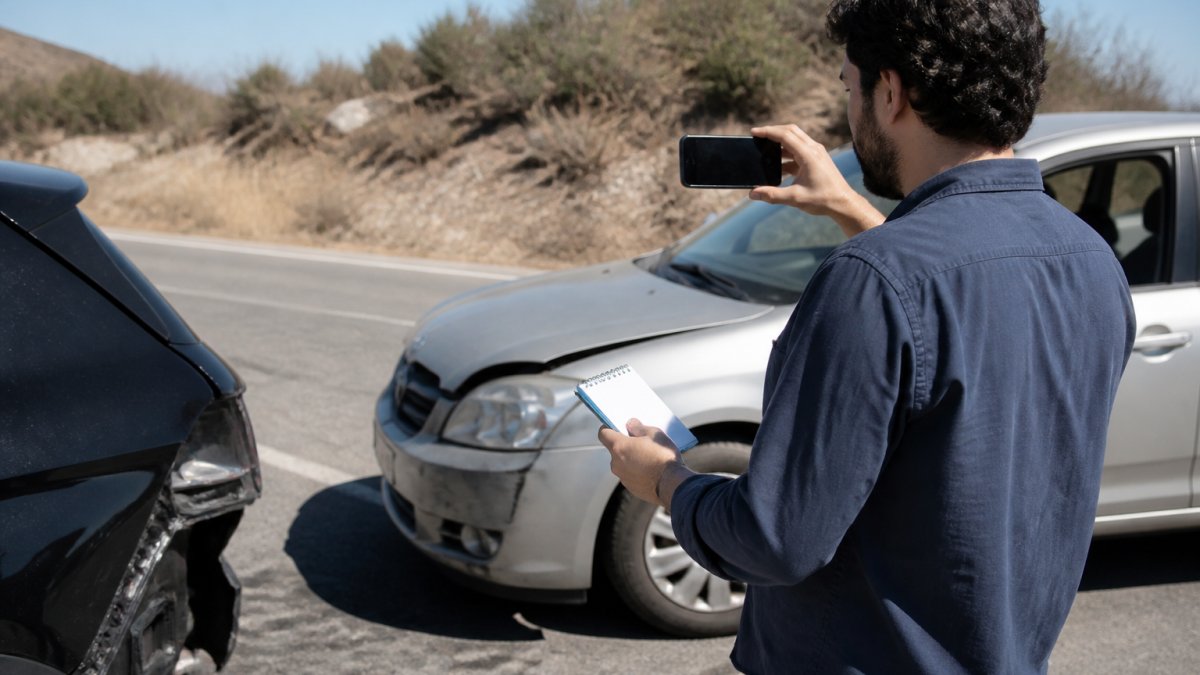
Gather these before you leave the scene if you can, and shoot wide before close:
- Wide shots showing where each car sits on the road, lane markings, and the position of traffic signals or signs
- Mid-range shots of both vehicles from four corners
- Close-ups of all damage, including paint transfer and cracks
Save everything to two places, like your phone and cloud storage. Note the time and location of each file. If you want a deeper look at which evidence may clarify a crash and how to preserve it, read our guide on what evidence helps after a California T-bone accident.
Keep the physical record intact
Do not rush repairs before the claim is documented. Keep the damaged vehicle available for inspection if possible, and save repair estimates, tow receipts, and rental records. If you must repair, photograph the damage first and keep the shop's estimate and final invoice. These records connect the damage to the crash and undercut a later claim that the damage was pre-existing.
What to do when evidence is already gone
If a camera was overwritten or a witness has moved, document the attempt. A dated note that you asked a business to preserve footage on a specific day, or a call log showing you tried to reach a witness, can still support your account.
Treat the first 24 to 72 hours as the critical window and preserve perishable evidence in this order.
| Evidence source | Action to take | Timing |
|---|---|---|
| Your own dashcam | Export original clip to cloud and second device | Now, before it overwrites |
| Nearby business cameras | Ask manager to preserve the clip | Same day |
| Doorbell and security cameras | Leave note with contact info, date, time | Same day |
| Phone driving and navigation data | Screenshot and export trip log | Same day |
| Scene photos | Shoot wide before close, save to two places | Before leaving scene |
| Damaged vehicle | Keep available for inspection; photograph before repairs | Before claim documented |
How to Get a Car Accident Witness Statement That Holds Up
A car accident witness statement is strongest when it is recorded early, in the witness's own words, and tied to a real name and contact number.
Ask politely for a name, phone number, and a short written note of what they saw.
A common mistake is collecting a name but no way to reach the person. Get two contact methods if possible.
What to Tell Insurance After a Car Accident When the Other Driver Lies
What to tell insurance after a car accident should be short, true, and consistent. Report the crash to your own insurer promptly, describe only what you personally saw, and avoid guessing about fault or speed.
Keep these rules in mind:
- Tell the truth and nothing more than you know
- Do not admit fault, even to be polite
- Do not speculate about what the other driver was doing
If the other driver's insurer calls, they may push for a recorded statement. For a closer look at coverage options and how to protect an injury claim, see our guide on car accident insurance lawyers in California.
How to Dispute an Insurance Claim Decision That Relies on False Claims
You can dispute an insurance claim decision by challenging the facts in writing and attaching evidence that contradicts the false account.
Start with a written letter or portal message. State exactly which claim you dispute and why.
Then follow up. Keep copies of everything and note who you spoke with. If the denial stands, ask for the reason in writing.
What to Do When the Police Report Is Wrong or Missing
An inaccurate or missing police report does not sink your claim, but you have to act. The first thing to understand is that a police report is evidence, not a final determination of fault. Officers often record conflicting statements without resolving them, and insurers are not bound by the report's characterization. That cuts both ways: a report that favors the other driver is not the end of the story, and a report that favors you still needs supporting evidence.
Get the report and read it line by line
Request a copy as soon as it is available. In many agencies, reports are released after a short processing period, and the process for requesting one varies by department. When you get it, compare it against your own notes on these points:
- The stated position and direction of each vehicle
- Who is listed as the driver of each car
- Whether your statement is summarized accurately
Ask for a correction or supplement
If something is wrong, contact the reporting agency and ask about their correction process. Many departments have a set way to submit a written correction request with supporting evidence. In practice, that usually means a short written statement identifying the specific error, attaching photos or witness information that contradicts it, and asking that the correction be added as a supplement rather than expecting the original report to be rewritten.
When no report exists
If no report exists, gather what you can: the officer's name and badge number, the incident number, and your own detailed notes from the scene. Your photos and witness statements can fill the gap. Document the timeline of what happened and when, including the date you requested the report and any response you received. If the agency confirms no report was taken, save that confirmation.
Use the report as one piece of the record
A report that contains the other driver's false version is still useful. It fixes the other driver's story in time, which makes later changes in that story easier to challenge. Pair the report with your photos, witness statements, and vehicle damage records so the overall record is consistent. If the report and the other driver's later statements conflict, point that out in writing to the insurer.
Deadlines and local rules vary
Reporting requirements, the time to request a report, and the rules for correcting one vary by jurisdiction. Some agencies have short windows for supplement requests, and some insurers expect a report number within a set period after the crash. Verify the local requirements for your crash location rather than relying on general guidance, and calendar the deadlines as soon as you know them.
When to Get an Attorney Involved for a False Accident Claim
Talk to an attorney when the other driver's story is shaping the claim, when injuries are serious, or when an insurer pressures you for a recorded statement. A false claim can stall or shrink a valid payout, and the clock on legal deadlines keeps running.
At Mamanne Law, attorney Benjamin Mamanne handles each case directly, in English or Spanish. If you are deciding whether to hire counsel, our page on attorney-led help after an auto accident shows how the claim gets organized. It also helps to know what a lawyer consultation involves and how to prepare before you call.
Request a Free Consultation About Your Accident Claim
A false story from the other driver is a problem you can fight, but the evidence window closes fast.
Mamanne Law offers a free consultation with direct access to attorney Benjamin Mamanne, bilingual support in English and Spanish, and no upfront legal fees.
Get started with Mamanne Law and request a free consultation about your accident claim today.
Frequently Asked Questions
How can I prove the other driver is lying about a car accident?
You prove it with evidence the other driver cannot control. That means photos of vehicle damage from multiple angles, video from dash cams or nearby businesses, a police accident report, witness statements collected at the scene, and your own medical records showing when injuries appeared. Keep a written log of every conversation with the other driver and any insurer, including dates, names, and what was said. Gaps and contradictions in the other driver's account, matched against physical evidence, are what an insurer or court weighs.
Should I tell the police if the other driver gives a false account?
Yes. Tell the responding officer exactly what you saw and ask that your version be included in the accident report. If the report is later filed with an inaccurate description, you can request a supplemental report or an amendment through the department that handled the crash. Do not argue with the other driver at the scene. Give your factual account to the officer, note the officer's name and badge number, and keep a copy of the report once it is available.
What should I say to the insurance company if the other driver lies?
Stick to facts you can verify: time, location, direction of travel, weather, road conditions, and what you observed. Do not speculate about the other driver's motives or admit fault. If an adjuster asks for a recorded statement, you can decline and offer a written account instead. Report the collision to your own insurer promptly, since your policy may require it, and provide the evidence you gathered. A personal injury attorney can handle insurer calls so your account stays consistent.
Can the other driver get in trouble for lying about an accident?
Knowingly giving false information on an insurance claim or police report can expose a driver to civil liability and, depending on the facts and state law, fraud allegations. Insurers investigate false claims because fraud raises costs for everyone. Your job is not to punish the other driver; it is to protect your own claim. Document contradictions, preserve evidence, and let your insurer and attorney address the false statements through the claims process.